
Start every trading day with a quick, actionable snapshot of global markets, key earnings, and the biggest movers across US, Europe, and Asia. Get the insight before your first coffee is gone.
May 27, 2026 | 157
Magnificent 7, Magnificent No More

Nikolay Stoykov
Managing Partner at Alaric Securities

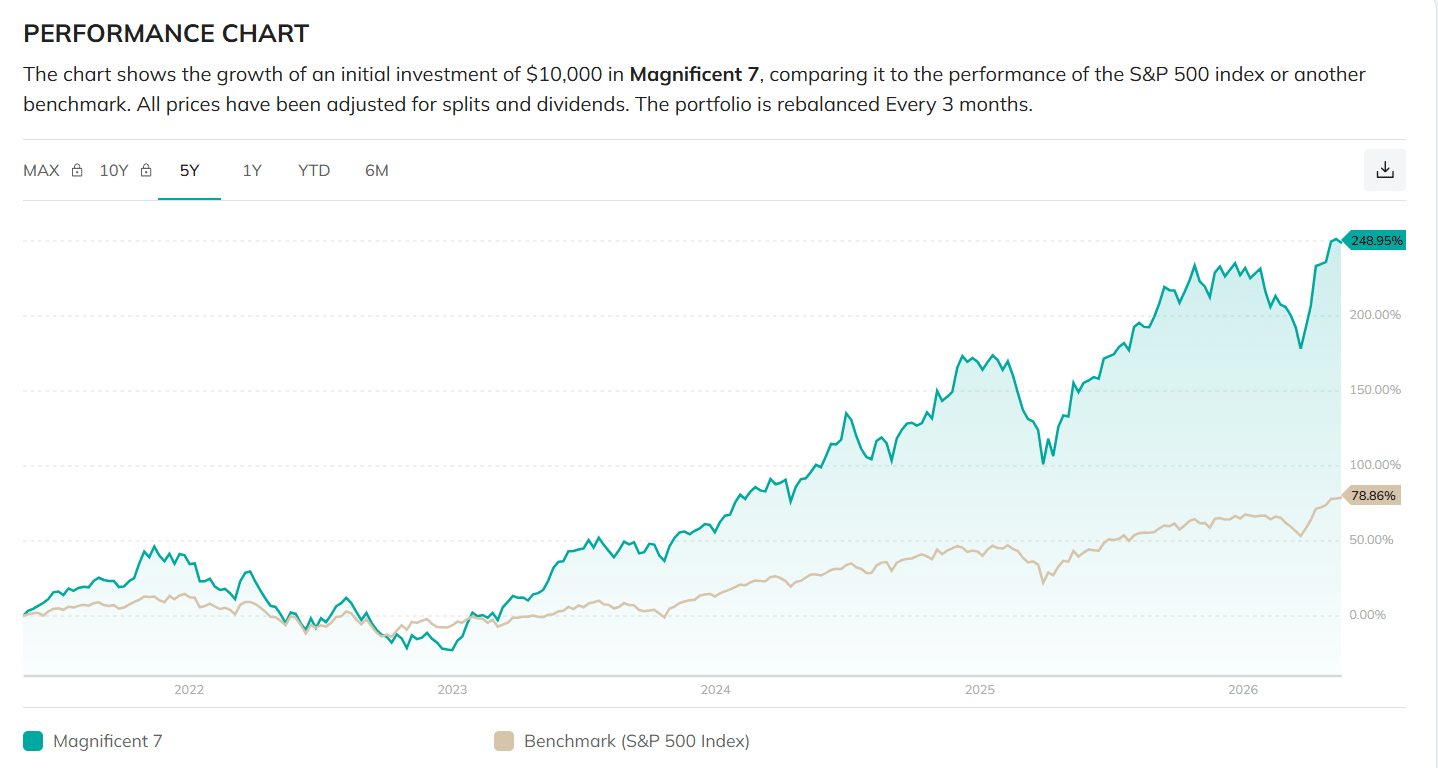
The Magnificent 7 have massively outperformed the S&P 500 over the past five years, in some cases returning several times as much as the index. The real question now is whether that era of dominance is coming to an end.
Over the last five years, the S&P 500 has returned approximately 80%, including dividends. During that same period, the Magnificent 7 stocks have returned nearly 250% — roughly three times more than the broader market. The group became “magnificent” for a reason: the returns have indeed been magnificent.
However, is that likely to continue?
What the Data Shows
We extracted data from finviz.com on forward P/E ratios and expected earnings growth over the next year for each stock, and compared these numbers with those for the S&P 500.
Data for the S&P 500 were obtained from State Street Global Advisors, the sponsor of the SPY ETF. The numbers are shown below:
| Forward PE | EPS Next Year | Forward PEG Ratio | |
| NVDA | 18,75 | 37,00% | 0,51 |
| GOOG | 26,20 | 14,70% | 1,78 |
| AAPL | 31,45 | 9,90% | 3,18 |
| MSFT | 21,70 | 15,80% | 1,37 |
| AMZN | 26,40 | 14,60% | 1,81 |
| TSLA | 170,00 | 28,60% | 5,94 |
| META | 17,35 | 6,40% | 2,71 |
| S&P500 | 22,70 | 17,20% | 1,32 |
Reading the Numbers
According to finviz.com — and verified by other sources — NVDA currently trades at a forward P/E ratio of 18.75, while next year’s earnings are expected to grow by 37%. That combination results in a forward PEG ratio, our favorite valuation statistic, of 0.51.
For context, the comparable numbers for the S&P 500 are a forward P/E ratio of 22.70 and expected earnings growth of 17.2%, resulting in a forward PEG ratio of 1.32. Generally speaking, the lower the PEG ratio, the cheaper the instrument relative to its expected growth.
The Valuation Problem
All other Magnificent 7 stocks currently trade at forward PEG ratios higher than the S&P 500’s. NVDA is the only stock in the group trading materially below the broader market on that basis. In fact, the discrepancy is so large that it raises the possibility that market participants may not fully trust current analyst estimates.
Still, let’s stick to the data we have and avoid unnecessary speculation.
What Comes Next
The data suggest that the Magnificent 7 group is unlikely to outperform the S&P 500 by a significant margin over the next year. If meaningful outperformance does occur, it will most likely be driven primarily by NVDA.
At present, several stocks in the group appear expensive relative to the broader market — particularly AAPL, TSLA, and META — while others such as MSFT, GOOG, and AMZN appear closer to fairly valued.
Based on current forward PEG ratios, NVDA remains the only clear value opportunity within the group.
Disclaimer
The articles, podcasts, and newsletters from Alaric Securities OOD are classified as marketing communications. The views expressed are solely those of the individual authors affiliated with Alaric Securities OOD and do not necessarily reflect the views of the company, its subsidiaries, or affiliates. This content is provided for informational purposes only. It does not constitute investment advice, a recommendation, or a solicitation to buy or sell any security, digital asset (such as cryptocurrency), or other financial instrument. Third-party content is included solely for informational purposes and does not reflect the views of Alaric Securities OOD. All investments involve risk, including the possible loss of principal. Past performance is not indicative of future results. References to third-party companies, logos, or trademarks are used under fair use/fair dealing principles for analysis and commentary.
Stay Ahead with Alaric Securities Newsletters
Traders and investors don't need more information - they need better information. That’s what we deliver!
Step back from the daily noise. Each issue explores market trends, industry shifts, trading opportunities, and exclusive updates — learn what's shaping the markets, not just what's trending online. Ready to get the edge?