
Start every trading day with a quick, actionable snapshot of global markets, key earnings, and the biggest movers across US, Europe, and Asia. Get the insight before your first coffee is gone.
July 7, 2026 | Issue 163
Japanese Yen Outlook – The Trade Is Turning

Nikolay Stoykov
Managing Partner at Alaric Securities

I have to admit that some of the inspiration for these blogs comes from ordinary conversations. It was probably several months ago that a friend of mine told me he was going on a vacation to Japan with several empty suitcases.
“The JPY is so low – everything is very cheap in Japan. If you have never been there, this is really a good time to go,” he said. It’s the kind of comment that makes you want to check the Japanese Yen outlook for yourself rather than take a friend’s word for it.
I turned to my trading screen and looked at the JPY Currency Index (JXY), pictured below on an annual basis, courtesy of TradingView.com.
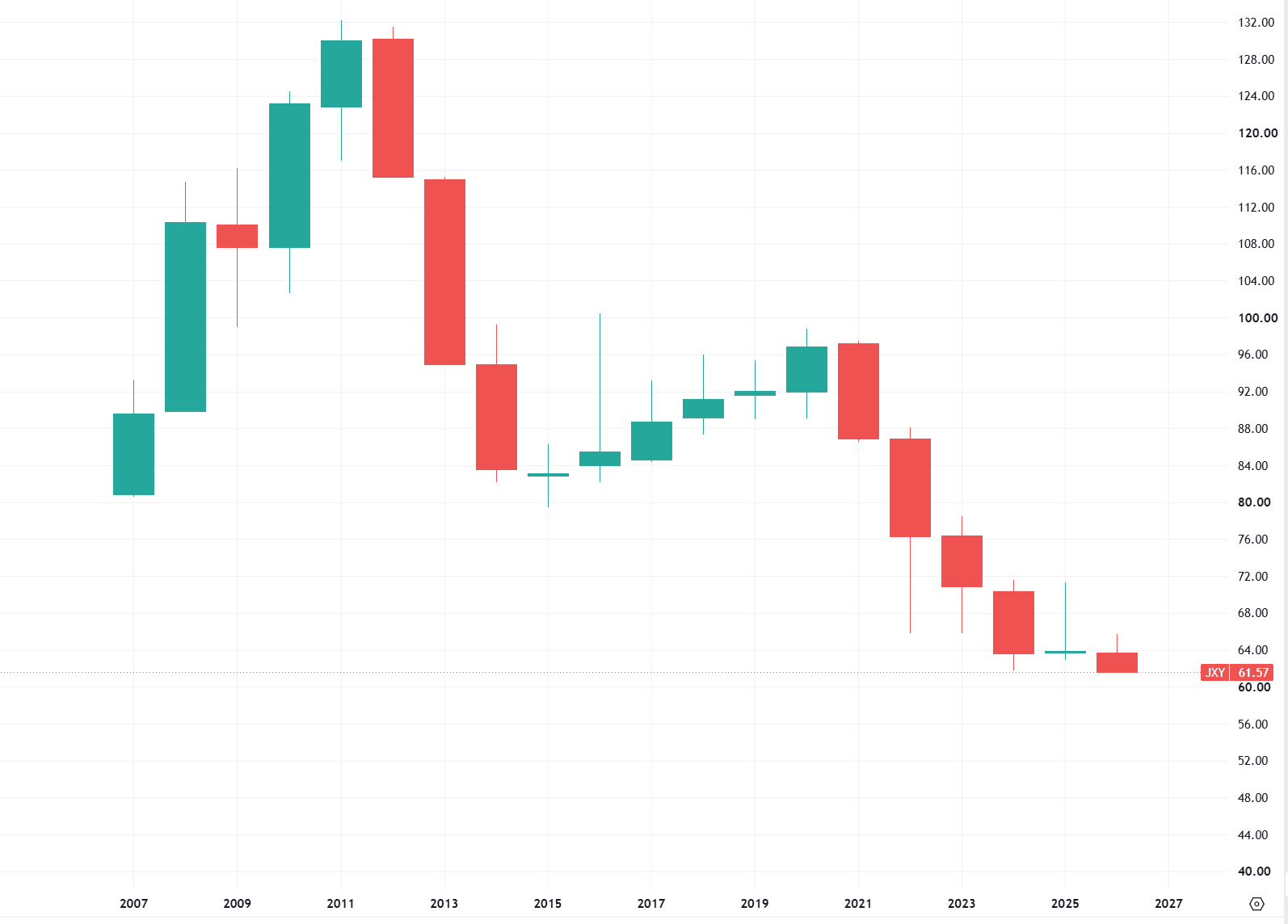
The JXY Index is a basket of foreign currencies, including the USD, EUR, CNY, CAD, CHF, and AUD. It provides a good indication of how the JPY is valued relative to the world’s major currencies.
While the performance against individual currencies varies, the overall dynamics have been remarkably similar. Since the beginning of 2021, the JPY has depreciated by about 50% against most major currencies. It has weakened by roughly 50% against the USD and CNY, 55% against the EUR, and 65% against the CHF, with an average depreciation of around 50%.
What the Inflation Numbers Say About the JPY
Over long periods, currency appreciation and depreciation tend to reflect differences in inflation and real interest rates. So, let’s start with inflation. We are going to compare the cumulative inflation rates of Japan, the Euro Area, and the United States from the end of 2021 through May 2026 using each region’s Consumer Price Index (CPI). The data are taken from TradingEconomics.com.
| Dec 2021 | May 2026 | % Change | |
|---|---|---|---|
| Japan CPI | 100.1 | 113.5 | 13% |
| US CPI | 278.8 | 335.2 | 20% |
| Euro Area CPI | 85.72 | 103.13 | 20% |
Why start at the end of 2021? Because that is when the sharp depreciation of the JPY appears to have begun. And why compare only the USD and EUR against the JPY? Simply because they are the two most actively traded currency pairs involving the yen.
Now that we have the data, it seems my friend may have a point. Japan experienced cumulative inflation of only 13% between December 2021 and May 2026, while both the United States and the Euro Area experienced inflation of approximately 20%. At the same time, the JPY depreciated by roughly 40% against the USD and 45% against the EUR, despite Japan’s inflation remaining noticeably lower than in both economies.
No wonder tourists have rediscovered Japan.
So Why Has the Yen Fallen So Far?
The answer comes down to divergent monetary policies among the Bank of Japan (BOJ), the Federal Reserve, and the European Central Bank. While the Fed and the ECB were aggressively raising interest rates and shrinking their balance sheets, the BOJ kept short-term interest rates near zero and continued to expand its balance sheet.
As a result, Japan became one of the cheapest funding currencies in the world, encouraging investors to borrow yen and invest in higher-yielding assets elsewhere.
Has the Story Changed? Rethinking the Japanese Yen Outlook for What Comes Next
However, that policy has gradually changed. Beginning in 2024, the BOJ started raising short-term interest rates, which currently stand at around 1%. In 2025, the BOJ also began reducing the size of its balance sheet.
With annual inflation running at approximately 1.5% as of May 2026, the BOJ may still need to tighten policy further. Still, the gap between inflation and short-term interest rates has narrowed significantly.
All of this reshapes the Japanese Yen outlook for the second half of 2026. In conclusion, while the narrative of “sell the JPY at any price” has worked remarkably well over the past five years, the fundamentals now appear considerably less supportive of further JPY depreciation.
Moreover, with inflation remaining below that of other major economies and Japanese interest rates finally converging toward domestic inflation, we believe the yen’s five-year story of one-way weakness is entering a different phase — one where currency direction will depend far more on the pace of BOJ tightening than on the funding-currency dynamics that dominated 2021–2024.
As for my friend, he still went to Japan with empty suitcases. Please note that the same trip may not be as cheap next year.
Disclaimer
The articles, podcasts, and newsletters from Alaric Securities OOD are classified as marketing communications. The views expressed are solely those of the individual authors affiliated with Alaric Securities OOD and do not necessarily reflect the views of the company, its subsidiaries, or affiliates. This content is provided for informational purposes only. It does not constitute investment advice, a recommendation, or a solicitation to buy or sell any security, digital asset (such as cryptocurrency), or other financial instrument. Third-party content is included solely for informational purposes and does not reflect the views of Alaric Securities OOD. All investments involve risk, including the possible loss of principal. Past performance is not indicative of future results. References to third-party companies, logos, or trademarks are used under fair use/fair dealing principles for analysis and commentary.
Stay Ahead with Alaric Securities Newsletters
Traders and investors don't need more information - they need better information. That’s what we deliver!
Step back from the daily noise. Each issue explores market trends, industry shifts, trading opportunities, and exclusive updates — learn what's shaping the markets, not just what's trending online. Ready to get the edge?