
Start every trading day with a quick, actionable snapshot of global markets, key earnings, and the biggest movers across US, Europe, and Asia. Get the insight before your first coffee is gone.
August 26, 2026 | Issue 168
Is a Recession Coming Soon

Nikolay Stoykov
Managing Partner at Alaric Securities

Is a recession coming? It’s a question that matters for traders and investors alike, and a 25-year chart of US labor data gives us a good place to start looking for an answer. Below is a chart from FRED showing the number of long-term unemployed people in the US alongside the number of job openings, both over the past 25 years.
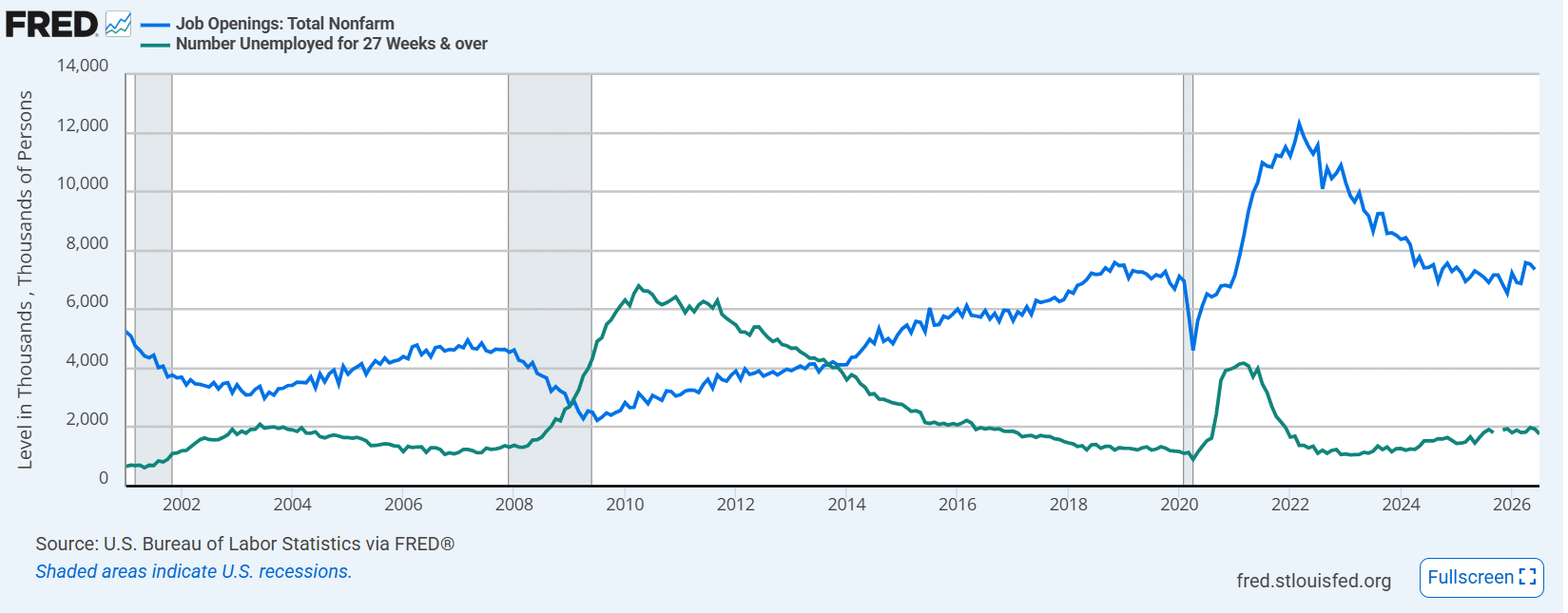
Pictured in green: number of long-term unemployed (over 27 weeks), in 000s. Pictured in blue: number of job openings in the US, in 000s.
The number of long-term unemployed people has varied from lows of around 700k in the early 2000s to highs of 6.8MM in 2010. Right now, that number is significantly above the lows of this business cycle — the current reading of nearly 1.8MM is almost twice the level seen in 2023, when it was close to 1MM.
It’s also worth noting that today’s 1.8MM, while far below the 2010 peak, is actually comparable to long-term unemployment during the early-2000s recession, when the figure peaked at 2.1MM in 2003.
Job openings tell a related story. US job openings have ranged from a low of 4.9MM in 2009 to a high of 12.3MM in 2022. The current reading of 7.4MM is well below the 2022 peak but comparable to the 2018 high of 7.6MM.
That comparison is where it gets strange – back in 2018, long-term unemployment was only 1.2MM. So the US currently has roughly as many job openings as it did in mid-2018, while long-term unemployment is 50% higher — nearly 1.8MM in 2026 versus 1.2MM in 2018.
One possible explanation is a growing mismatch between the skills the economy needs and the skills many long-term unemployed workers have.
Is a Recession Coming? What Total Employment Shows
These two data series need context, and that context is total nonfarm employment. Below is a 25-year chart of that series, also from FRED.
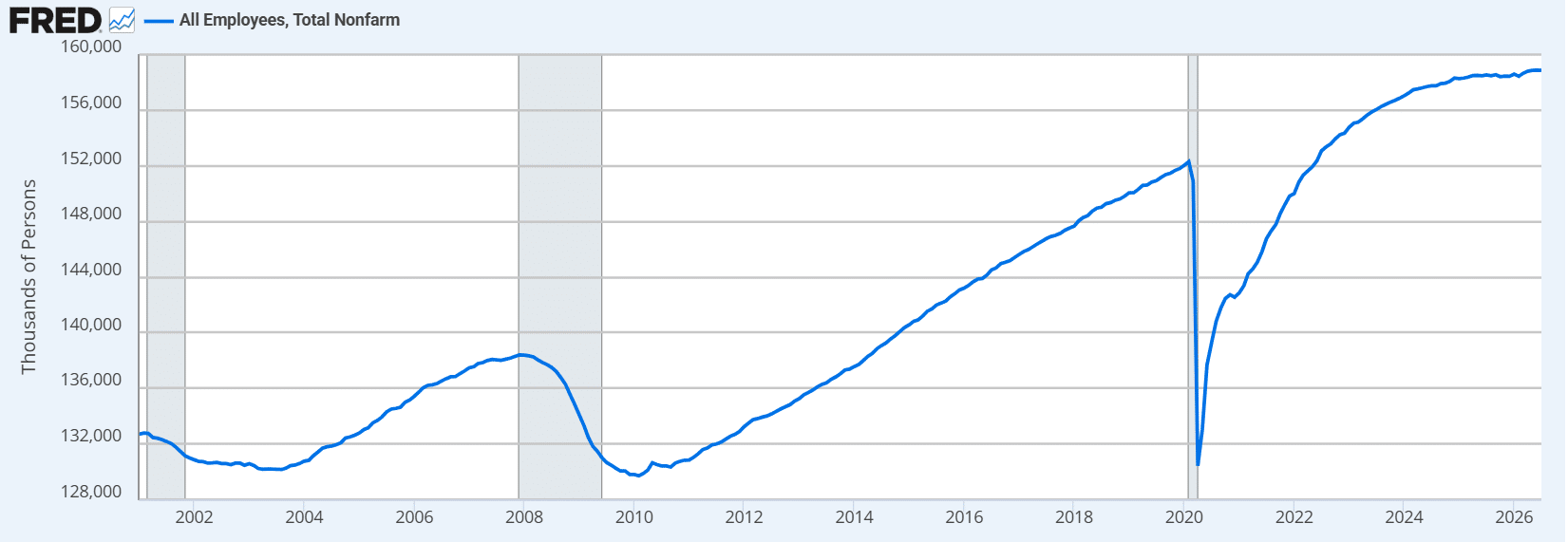
Total nonfarm employment has grown since the early 2000s from around 132MM to approximately 159MM in 2026. The concerning part is that employment has largely plateaued since late 2024.
We saw a similar pattern in 2007, near the top of that business cycle — though a plateau alone isn’t proof that a recession is imminent.
What the VIX Is Telling Traders Right Now
Current market positioning in equities and credit doesn’t signal a clear top yet, but one marke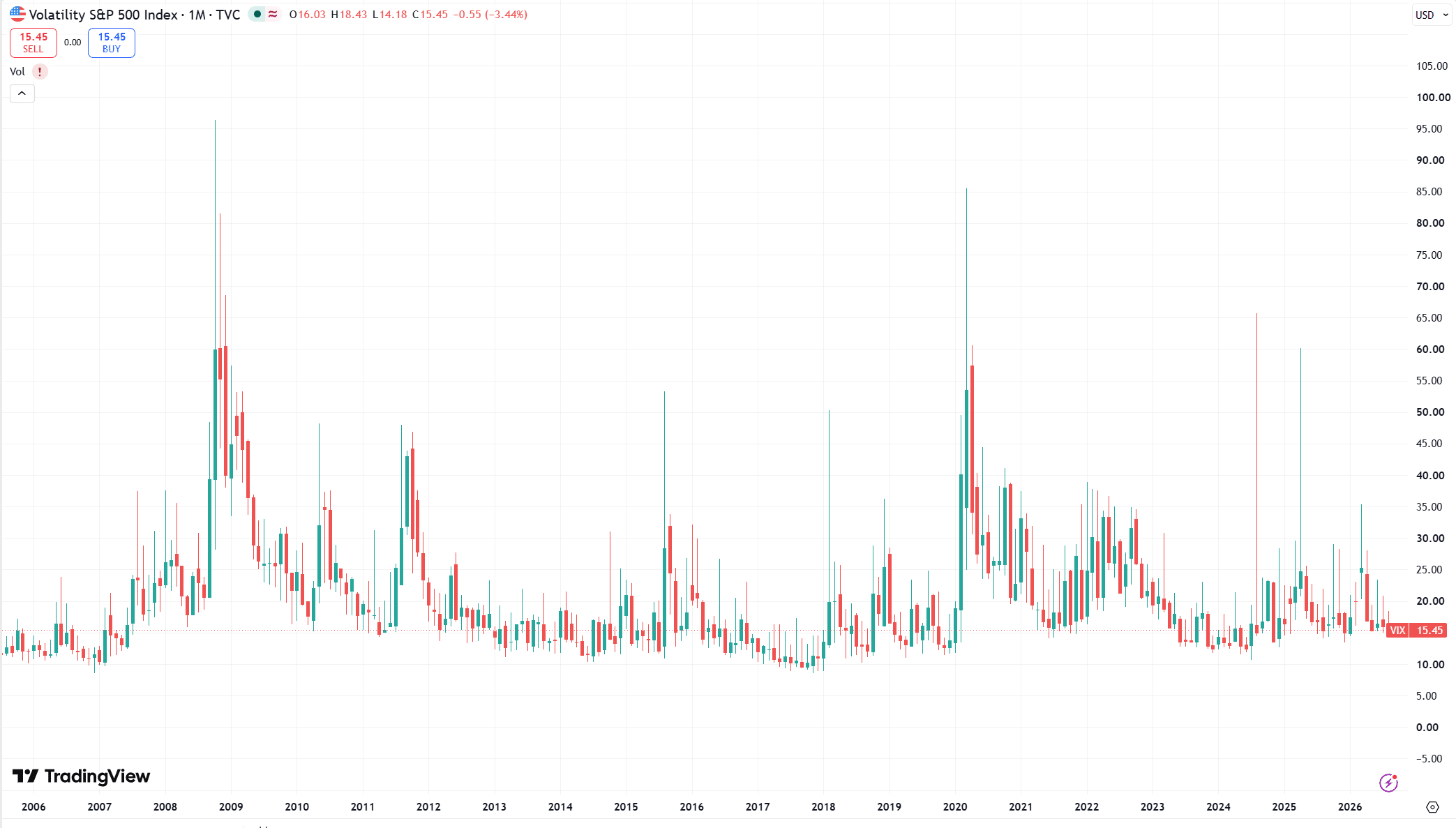 t indicator warrants caution: volatility. Below is a 25-year chart of the CBOE Volatility Index (VIX), courtesy of TradingView.
The VIX is trading at roughly the same levels as in 2024. The current reading of around 15.50 isn’t high in absolute terms, but it remains above the lows of nearly 10 seen in 2018, and it points to some uncertainty about the forward distribution of S&P 500 returns. That uncertainty alone doesn’t mean a recession is coming. Combined with a weakening labor market, though, it argues for more caution toward the bullish price action we’re seeing in risky assets.
The Risk Markets Aren’t Pricing In
Every market participant is, to some degree, a trend follower. It’s a natural human behavior — and margin requirements, risk management, and capital allocation decisions are shaped not just by valuations but also by recent performance. The underlying assumption most traders make is that if a recession comes, markets will react first, giving investors time to exit after the reaction begins.
The flaw in that thinking is the assumption that the initial reaction will be mild. What if it isn’t? What if the shift from bullish to bearish price action happens as abruptly as it did in 2020, at the onset of the COVID pandemic, with no dead-cat bounce and no greater fool left to sell a long position to?
We’re not saying this will happen — only that it’s a real possibility. Trend following is a proven, workable concept, but trend changes can be unpredictable and don’t require a bounce first. We view the weakness in the labor market and the current level of implied volatility as serious caution flags for capital allocation, and we estimate the odds of a recession in the near future are probably above 50%.
So, Is a Recession Coming? Our Take
The data doesn’t point to an imminent recession with certainty — but long-term unemployment near 2003 levels, a plateaued labor market, and a VIX sitting above its 2018 lows are enough caution flags that traders should be reviewing their risk exposure now, not after the shift begins.
Disclaimer
The articles, podcasts, and newsletters from Alaric Securities OOD are classified as marketing communications. The views expressed are solely those of the individual authors affiliated with Alaric Securities OOD and do not necessarily reflect the views of the company, its subsidiaries, or affiliates. This content is provided for informational purposes only. It does not constitute investment advice, a recommendation, or a solicitation to buy or sell any security, digital asset (such as cryptocurrency), or other financial instrument. Third-party content is included solely for informational purposes and does not reflect the views of Alaric Securities OOD. All investments involve risk, including the possible loss of principal. Past performance is not indicative of future results. References to third-party companies, logos, or trademarks are used under fair use/fair dealing principles for analysis and commentary.
Stay Ahead with Alaric Securities Newsletters
Traders and investors don't need more information - they need better information. That’s what we deliver!
Step back from the daily noise. Each issue explores market trends, industry shifts, trading opportunities, and exclusive updates — learn what's shaping the markets, not just what's trending online. Ready to get the edge?