
Next Fed Chair: Who Deserves the Job


For the regular readers of the Market Insights series, it should come as no surprise that we are not fans of Mr. Jerome Powell. There are multiple reasons for that, but it invariably comes down to the fact that Mr. Powell has consistently pursued monetary policies that differ from what traditional monetary policy theory has suggested.
The narrative in the news has been that his policies are unorthodox. Unorthodox sounds chic, but it could also mean incorrect or untested — and the only way to know whether something is true is if it survives the test of time. By definition, unorthodox policies are unorthodox because they have not survived the test of time. If they had, they would simply be orthodox.
We do miss Mr. Ben Bernanke — the Federal Reserve Chairman during the Great Financial Crisis of 2008. He navigated one of the most dangerous financial episodes in modern history while containing inflation to levels few expected. With hindsight, his performance looks even stronger.
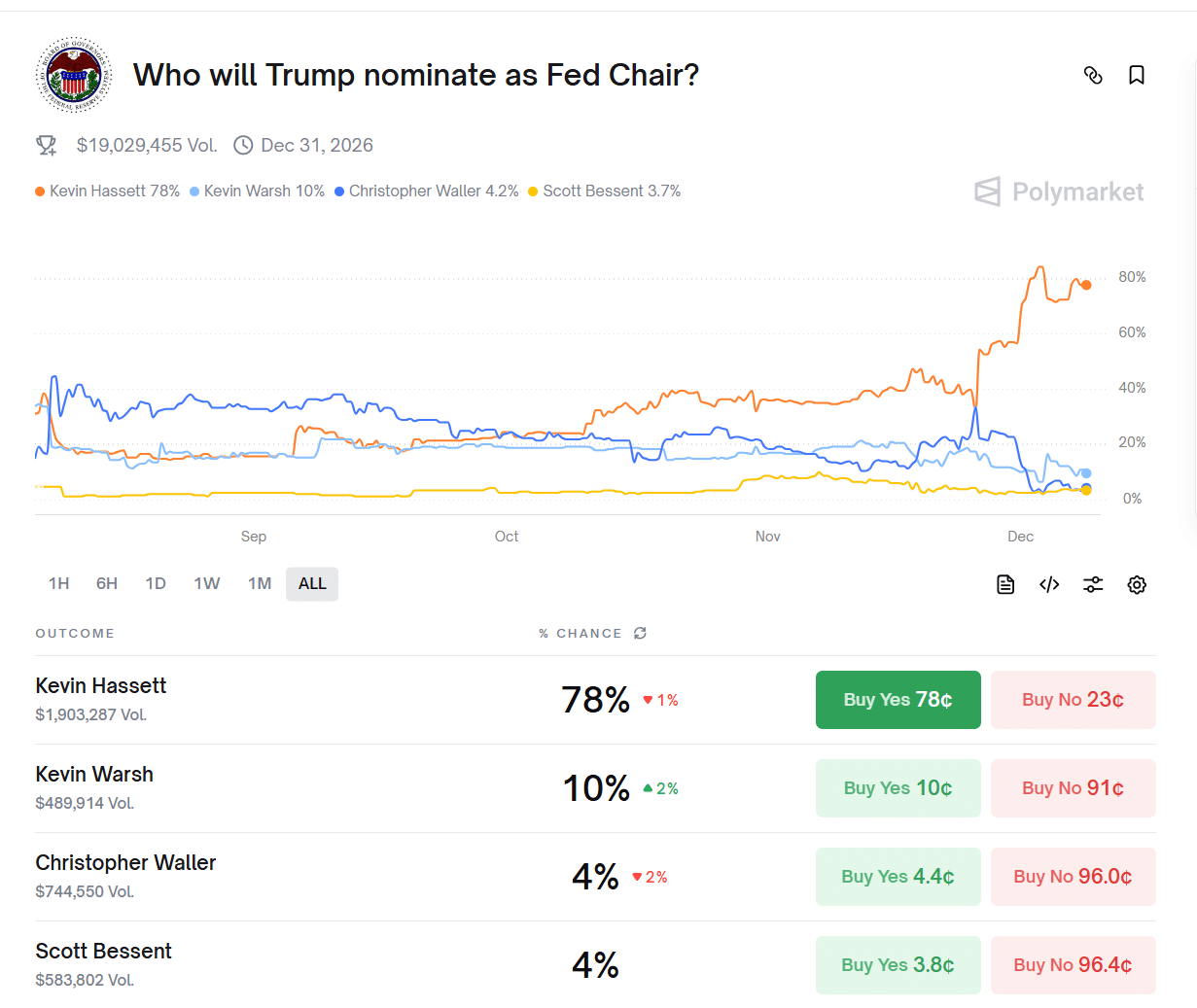
Mr. Powell’s term ends on 15/5/2026, so now is an appropriate moment to evaluate who might become the next Chairman. Since markets allow people to bet on almost anything, we reviewed the odds posted on polymarket.com.
The Betting Markets’ Favorite Isn’t the Most Qualified
Since late November, one candidate has surged with oddsmakers: Kevin Hassett. The current odds — 78% for Hassett, 10% for Kevin Warsh, 4% for Christopher Waller, and 4% for Scott Bessent — suggest that one of these four will likely become the next Chairman, with Mr. Hassett leading for now.
To assess these candidates more systematically, we compared them to the previous four Federal Reserve Chairs — Mr. Greenspan, Mr. Bernanke, Ms. Yellen, and Mr. Powell.
How the Candidates Compare on Core Qualifications
There is no formal list of Fed Chairman qualifications, but several criteria recur in practice. We grouped the candidates’ backgrounds into four categories: Education, Fed Governor Experience, Government Experience, and Broad Political Support. To provide context, we included the last four Chairs as reference points.
| Education | Fed Governor Experience years | Broad Political Support | Public Service Experience years | Current Odds | |
| Allan Greenspan | PhD Economics | 0 | Yes | 3 years | |
| Ben Bernanke | PhD Economics | 2.5 years | Yes | 2.5 years | |
| Janet Yellen | PhD Economics | 3 years | Yes | 15 years | |
| Jerome Powell | JD | 5.5 years | Yes | 6 years | |
| Kevin Hassett | PhD Economics | 0 years | No | 2 years | 78% |
| Kevin Warsh | JD | 5 years | No | 9 years | 10% |
| Christopher Waller | PhD Economics | 5 years | Yes | 15 years | 4% |
| Scott Bessent | BA Political Science | 0 years | No | 1 year | 4% |
It is clear that the next Fed Chairman should hold an advanced degree — ideally a PhD in economics. While Mr. Powell earned JD rather than PhD he still holds advanced academic credentials. On this criterion alone, Mr. Bessent, who has only a BA in Political Science, stands out as the least qualified. The market reflects this with a modest 4% probability assigned to his candidacy. All other candidates meet the education bar.
Moving on to Fed Governor experience, we observe that most previous Fed Chairs did serve as Fed Governors prior to assuming the post. Strangely enough, the leading candidate — Kevin Hassett — does not have such experience, while both Kevin Warsh and Christopher Waller do. This is not sufficient to conclude that Mr. Hassett is unsuitable or will not be nominated, but it does mean that Mr. Waller and Mr. Warsh are objectively stronger in this category.
Regarding public service experience, all candidates have at least some.
Finally, we examine broad political support. Unfortunately for the frontrunner, Mr. Hassett lacks it. He is well known as a Trump loyalist, which makes his path to confirmation risky. His nomination would require 100% support from all Republican Senators. If even one defects, his candidacy may fail. Mr. Warsh faces a similar challenge due to his perceived closeness to President Trump.
How the Leading Candidates Stack Up Against Past Fed Chairs
This leaves Mr. Waller — who, as a current Federal Reserve Governor, has remained largely neutral in the charged political environment. His nomination would be the easiest to confirm and would not rely on unanimous Republican support.
Conclusion
Although the betting markets currently treat Mr. Hassett as the frontrunner, his nomination faces clear hurdles, particularly his close association with President Trump and the requirement for full Republican support in the Senate.
In our view, Mr. Hassett falls short of the qualifications we should expect from the next Fed Chair.
If nominated, Mr. Waller would likely move through the confirmation process with far fewer obstacles. Based on the four criteria we evaluated, he appears to be the strongest candidate on paper and the most credible successor to Mr. Powell.