
How Gulf Markets Are Pricing Middle East Conflict


Why the UAE, Saudi Arabia, Qatar, and Kuwait Markets Are Moving Differently
The Middle East conflict has dominated financial news over the past month, and understandably so. Oil remains one of the world’s most critical commodities, and the ongoing tensions have significantly increased both its price and volatility. The rhetoric on all sides has become increasingly confrontational, raising concerns that the situation could escalate into a broader regional war.
We are not military specialists and don’t have access to non-public information. However, markets often provide a useful lens for assessing risk. With that in mind, we examined the performance of local equity markets in the Gulf region.
Since these markets trade in local currencies, we focused on their ETF proxies — UAE, Qatar, Kuwait, and Saudi Arabia — and compared them with the SPDR S&P 500 ETF Trust.
Market Divergence During the Middle East Conflict
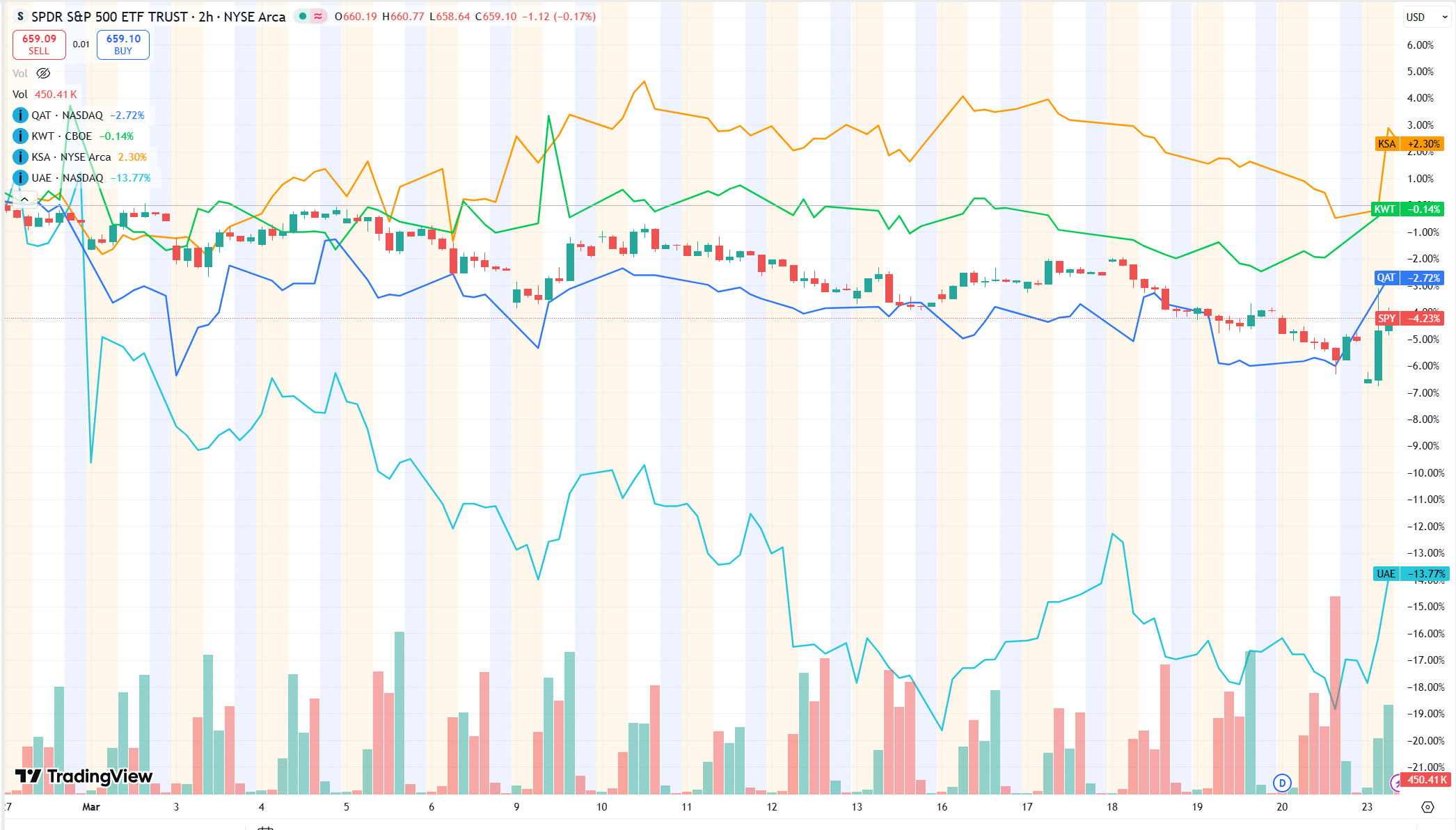
Looking at intraday performance since the end of February 2026 (data courtesy of TradingView), the divergence is the signal.
The UAE ETF has declined sharply by –13.77%, significantly underperforming the SPDR S&P 500 ETF Trust, which is down –4.23% over the same period. Qatar has fallen –2.72%, Kuwait is nearly flat at –0.14%, while Saudi Arabia stands out with a gain of +2.3%.
This dispersion is not random. While the conflict may still evolve into a wider regional crisis, markets are not pricing a uniform escalation across the Gulf. Instead, they are differentiating with precision between countries based on economic structure and exposure.
UAE, Saudi Arabia, and the Asymmetry of Risk
The UAE’s underperformance reflects its sensitivity to disruptions in capital flows, tourism, and aviation — sectors that reprice immediately under geopolitical stress.
In contrast, Saudi Arabia’s positive performance suggests that higher oil prices are, at least for now, converting regional instability into incremental earnings. Qatar and Kuwait sit in between, balancing energy-related support with broader uncertainty.
What Markets Are Signaling About the Middle East Conflict
We do not claim that markets are perfectly efficient or that they fully capture tail risks. However, they remain one of the most effective mechanisms for aggregating dispersed information and sentiment in real time. The current pricing across Gulf ETFs suggests that investors are, at this stage, assigning a relatively contained probability to a full-scale regional escalation.
The situation remains fluid, and future developments could quickly alter this assessment. For now, market behavior points to a more nuanced conclusion: not the absence of risk, but a selective and asymmetrical pricing of it across the region.