
Global Recession 2026: What to Expect

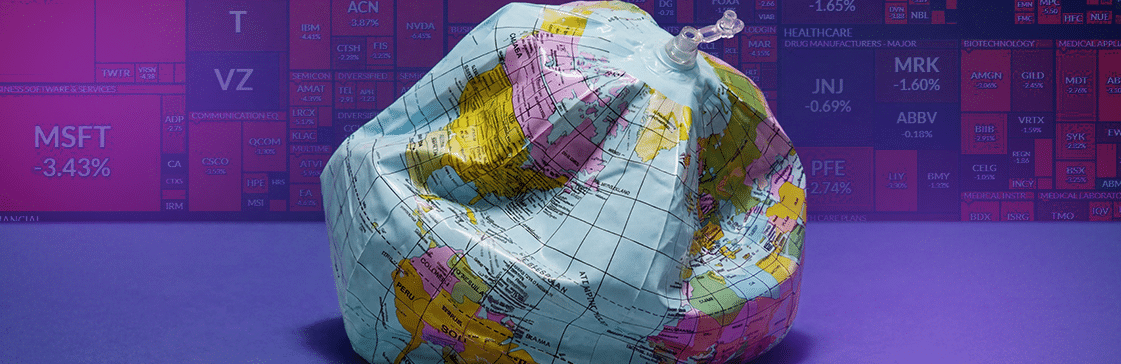
Could a Global Recession in 2026 Push Markets Into Freefall
If the global economy were to enter a recession in 2026, how far could equity markets realistically fall?
The honest answer is that nobody knows. However, statistics can still help us frame a reasonable range of outcomes.
What History Tells Us About Recession-Driven Market Declines
For those of you who may not remember their mathematics, it is useful to recall a principle from the Law of Large Numbers: in the long run, observed frequencies approach the true probability.
A simple illustration is flipping a coin. If you flip a coin enough times — say more than 100 — the observed probability of heads or tails will tend to converge toward the true probability, which in this case is 50%.
When thinking about the potential distribution of market outcomes in a possible 2026 recession, the most natural approach would be to examine enough past recessions to form a meaningful statistical sample. Unfortunately, structural changes in the economy and in policy make this difficult.
The Federal Reserve’s maximum employment mandate was only explicitly introduced in 1977 with the Federal Reserve Reform Act of 1977. Moreover, it was only in the 2000s that the Federal Reserve began intervening much more actively in financial markets, particularly through policies such as Quantitative easing.
This leaves us with two imperfect approaches.
Approach A: include 7–10 recessions from the past, knowing that much of the older data reflects a very different monetary regime.
Approach B: focus only on the most recent recessions, accepting that while the data may be more relevant, the statistical sample will be small and the margin of error large.
We opted for Approach B, focusing on recessions over the last 25 years.
The Last Three Recessions: A Data Snapshot
Looking at the last three recessions — 2001, 2007–2009, and 2020 — the S&P 500 declined peak-to-trough by approximately:
- 49% in 2001
- 57% in 2007–2009
- 34% in 2020
This results in an average decline of roughly 47%, with a standard deviation of about 10%.
If a recession were to occur in 2026, a simple statistical interpretation would therefore suggest a possible decline around that average. A very rough ±2 standard deviation range would imply a decline between 27% and 67%.
If we assume a hypothetical peak of 7000 in the S&P 500, this would correspond to a mean estimate around 3710, with a broad range between 2110 and 5110.
Of course, this is simply what the numbers imply — not necessarily what will happen.
Why Each Recession Was Different and Why It Matters for 2026
Each of the three recessions had very different underlying drivers.
The 2001 recession was largely the result of the collapse of the dot-com bubble. The defining feature was the contraction of excessively optimistic growth expectations in technology companies. While there were some credit concerns, there was no systemic banking crisis.
The 2007–2009 recession was fundamentally different. It was a credit crisis marked by a severe breakdown of trust in the banking system, leading to the collapse or near-collapse of several major financial institutions. This explains why the decline in the S&P 500 was particularly severe.
The 2020 recession, on the other hand, was triggered by an extremely rare external shock — the global pandemic. In response, central banks implemented unprecedented monetary stimulus, including aggressive quantitative easing. This contributed to a relatively shallow recession followed by a surge in inflation.
Which Recession Does 2026 Most Resemble
A global recession 2026 scenario is unlikely to mirror 2020. Black swan events can occur, but building an investment thesis around them is unwise. Central banks are also acutely aware of the inflationary consequences of 2020–2021 policy responses and may be reluctant to repeat them.
The conditions behind 2007–2009 — excessive leverage, lax credit standards, widespread regulatory complacency — are also less prevalent today, following the extensive reforms introduced after that crisis.
That leaves 2001 as the closest analogue. That episode was largely a compression of risk-premium valuations after a prolonged period of market exuberance.
Which Asset Classes Could Be Most Vulnerable
Several asset classes have delivered well-above-average returns over the past decade — most notably technology stocks, real estate, and precious metals. A global recession in 2026 would not necessarily push all of them lower. However, in such an environment, each could prove particularly vulnerable to valuation correction.