
Start every trading day with a quick, actionable snapshot of global markets, key earnings, and the biggest movers across US, Europe, and Asia. Get the insight before your first coffee is gone.
April 30, 2026 | Issue 154
UAE Exit from OPEC: What It Changes and What It Doesn’t

Nikolay Stoykov
Managing Partner at Alaric Securities

The UAE exit from OPEC, effective May 1, 2026, marks the most consequential departure from the cartel in years, but its impact is more gradual than dramatic.
The Organization of the Petroleum Exporting Countries (OPEC) was founded in 1960 by Iran, Iraq, Kuwait, Saudi Arabia, and Venezuela. Today, it remains a coordinated group of major oil producers aiming to influence global supply.
The recent decision by the United Arab Emirates to leave OPEC (effective May 1, 2026) is therefore notable, but not existential for the organization.
Where the UAE Stands in OPEC, Just Before the Exit
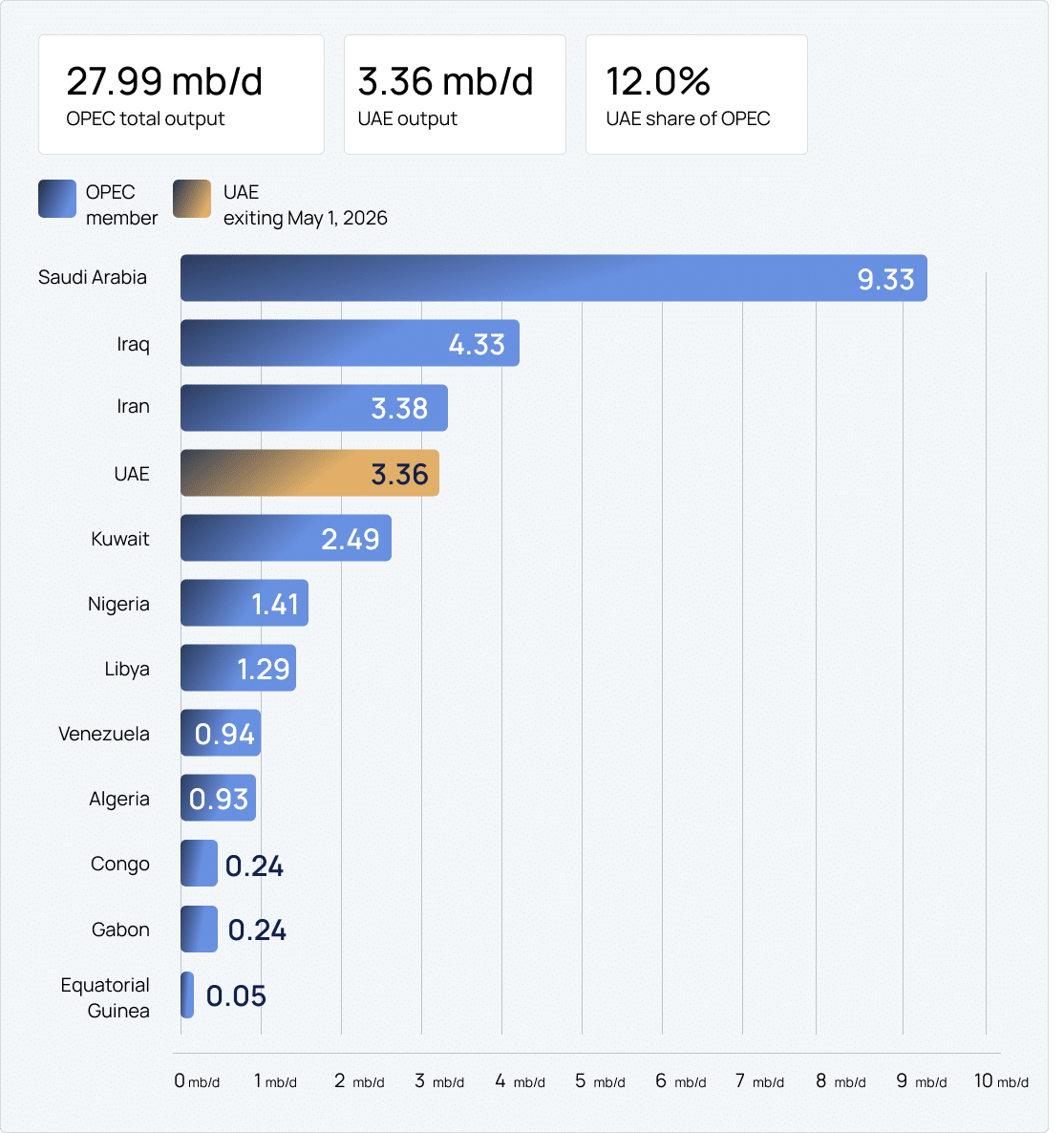
The UAE is not a marginal player. It is one of the largest producers in OPEC, accounting for a meaningful share of total output and, more importantly, possessing significant spare capacity — on the order of 1 million barrels per day. However, it is also not the dominant force — that role clearly belongs to Saudi Arabia, followed by Iraq, with Iran a sanctioned wildcard whose actual output sits well below its capacity.
At first glance, the UAE’s exit does not threaten OPEC’s existence. The organization has seen departures before — for example, Qatar in 2019 — and has continued to function.
Why the UAE is leaving OPEC
The more important question is why the UAE is leaving.
While geopolitical considerations may play a role, the primary driver appears to be economic. The UAE has increasingly found OPEC production quotas restrictive, particularly given its ability and ambition to expand output. Leaving the organization effectively removes those constraints, allowing it to pursue a more independent production strategy.
There is also a secondary layer of intra-OPEC tension, particularly with Saudi Arabia, where differing views on quotas and market strategy have been visible in recent years.
What the UAE’s OPEC exit means for oil markets
The implication is not the collapse of OPEC, but a gradual weakening of cartel discipline. If one of the more capable producers chooses flexibility over coordination, it introduces a structural shift:
- Less cohesion within OPEC
- Greater competition for market share
- Potentially higher oil price volatility over time
In the short term, the impact may be limited. However, over the longer term, the UAE’s decision signals a shift away from coordinated supply management toward more independent, market-driven production.
Disclaimer
The articles, podcasts, and newsletters from Alaric Securities OOD are classified as marketing communications. The views expressed are solely those of the individual authors affiliated with Alaric Securities OOD and do not necessarily reflect the views of the company, its subsidiaries, or affiliates. This content is provided for informational purposes only. It does not constitute investment advice, a recommendation, or a solicitation to buy or sell any security, digital asset (such as cryptocurrency), or other financial instrument. Third-party content is included solely for informational purposes and does not reflect the views of Alaric Securities OOD. All investments involve risk, including the possible loss of principal. Past performance is not indicative of future results. References to third-party companies, logos, or trademarks are used under fair use/fair dealing principles for analysis and commentary.
Stay Ahead with Alaric Securities Newsletters
Traders and investors don't need more information - they need better information. That’s what we deliver!
Step back from the daily noise. Each issue explores market trends, industry shifts, trading opportunities, and exclusive updates — learn what's shaping the markets, not just what's trending online. Ready to get the edge?