
Start every trading day with a quick, actionable snapshot of global markets, key earnings, and the biggest movers across US, Europe, and Asia. Get the insight before your first coffee is gone.
December 3, 2025 | Issue 136
Microsoft Stock Outlook: Buy, Hold, or Avoid Right Now

Nikolay Stoykov
Managing Partner at Alaric Securities

We have written about Microsoft stock (Nasdaq: MSFT) several times before—most recently in October 2024, when the stock was trading near USD 420, and we viewed it favorably. A little over a year later, with the share price now around USD 486, the long-term setup merits another look.
Microsoft Inc. has continued to outperform much of the market, driven by structural demand for cloud services and accelerating interest in enterprise AI. With the valuation now higher, investors naturally want to know whether MSFT remains attractive at current levels or whether expectations have outpaced fundamentals.
Analyst Ratings — Broadly Positive and Consistent
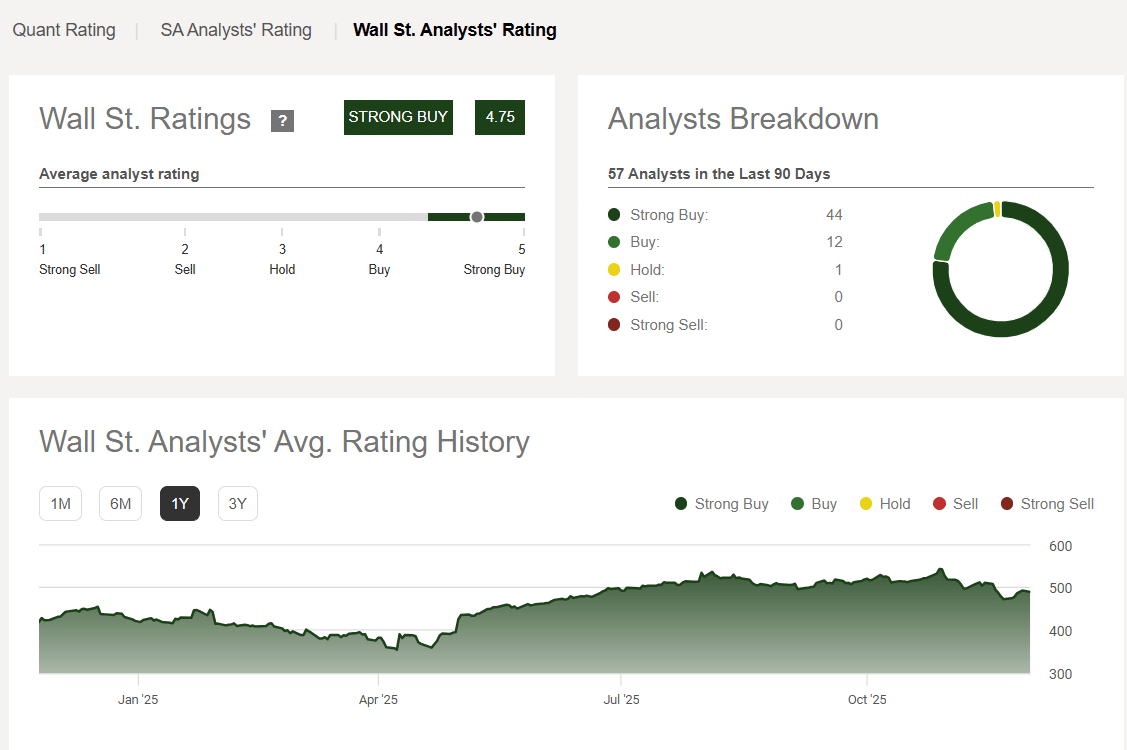
According to Seeking Alpha, 57 analysts have issued ratings on MSFT over the past 90 days:
-
44 Strong Buys
-
12 Buys
-
1 Hold
Using Seeking Alpha’s scoring system (Strong Sell = 1 to Strong Buy = 5), Microsoft currently stands at 4.75 out of 5. This is one of the most positive analyst profiles the company has received in recent years — and what makes it notable is that this sentiment persists even though the stock has already appreciated significantly over the past twelve months.
In other words, analysts are not simply reacting to a low valuation or a recent selloff; they continue to see meaningful upside ahead.
Much of this confidence is tied to Microsoft’s continued leadership in cloud computing and its early advantage in applied AI. Even as competitors invest aggressively in similar technologies, Microsoft benefits from a unique combination of product depth, ecosystem scale, and enterprise relationships.
Recent Developments — AI Momentum and Platform Expansion
Part of the reason analysts remain constructive is that Microsoft continues to demonstrate tangible progress across key growth areas. Over the past several months:
-
AI monetization is gaining traction, particularly with the rollout of Microsoft Copilot, with early enterprise adoption signaling meaningful long-term potential.
-
Azure’s growth continues to benefit from strong AI demand. Azure AI services are expanding rapidly, even if overall Azure growth has occasionally been constrained by data-center capacity rather than weak demand.
-
The OpenAI partnership remains a major differentiator, giving Microsoft priority access to advanced models and enabling deep integration across Microsoft 365, Windows, Azure, and developer tools.
- The Activision Blizzard acquisition has broadened Microsoft’s gaming scale and recurring-revenue potential.
These developments reinforce the idea that Microsoft is not just benefiting from cyclical momentum but is actively strengthening its long-term competitive positioning.
Price Targets — Trading Near the Low End of the Range
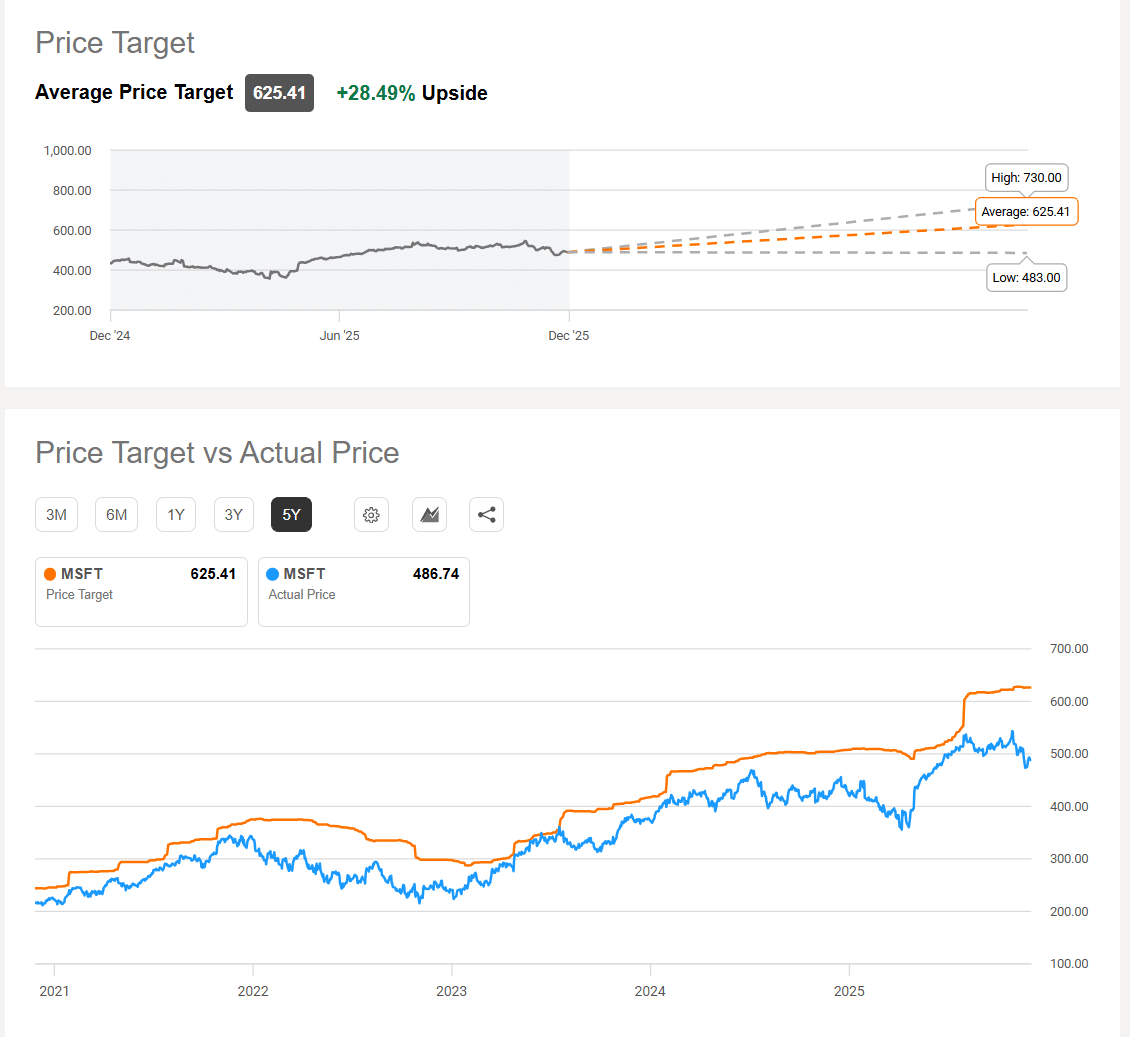
Price-target data from Seeking Alpha indicates:
-
Lowest target: USD 483
-
Average target: USD 625
-
Current price: ~USD 486
This places the stock close to the lower end of its published target range. Historically, Microsoft stock tends to trade 17%–19% below its average price target. In more volatile periods — including the spring of 2025 — the discount has widened to nearly 35%.
The current gap of roughly 28.5% (USD 486 vs. USD 625), therefore, sits toward the wider end of its historical range. This positioning supports the view that Microsoft remains reasonably priced relative to analyst expectations, even if the absolute valuation is not inexpensive.
From a long-term investor’s perspective, buying high-quality companies when they are trading near the bottom of their consensus ranges , while analyst sentiment remains strong, is often a constructive strategy. Microsoft stock currently fits this profile.
Valuation and Market Positioning
Microsoft continues to trade at a premium relative to the broader market, a premium generally justified by the company’s stability, growth prospects, and recurring revenue base. Its forward P/E typically falls in the high-20s to low-30s range, placing it above the S&P 500 but below some high-growth technology peers. The market appears willing to pay for consistency and strategic leadership in AI — two qualities Microsoft continues to demonstrate.
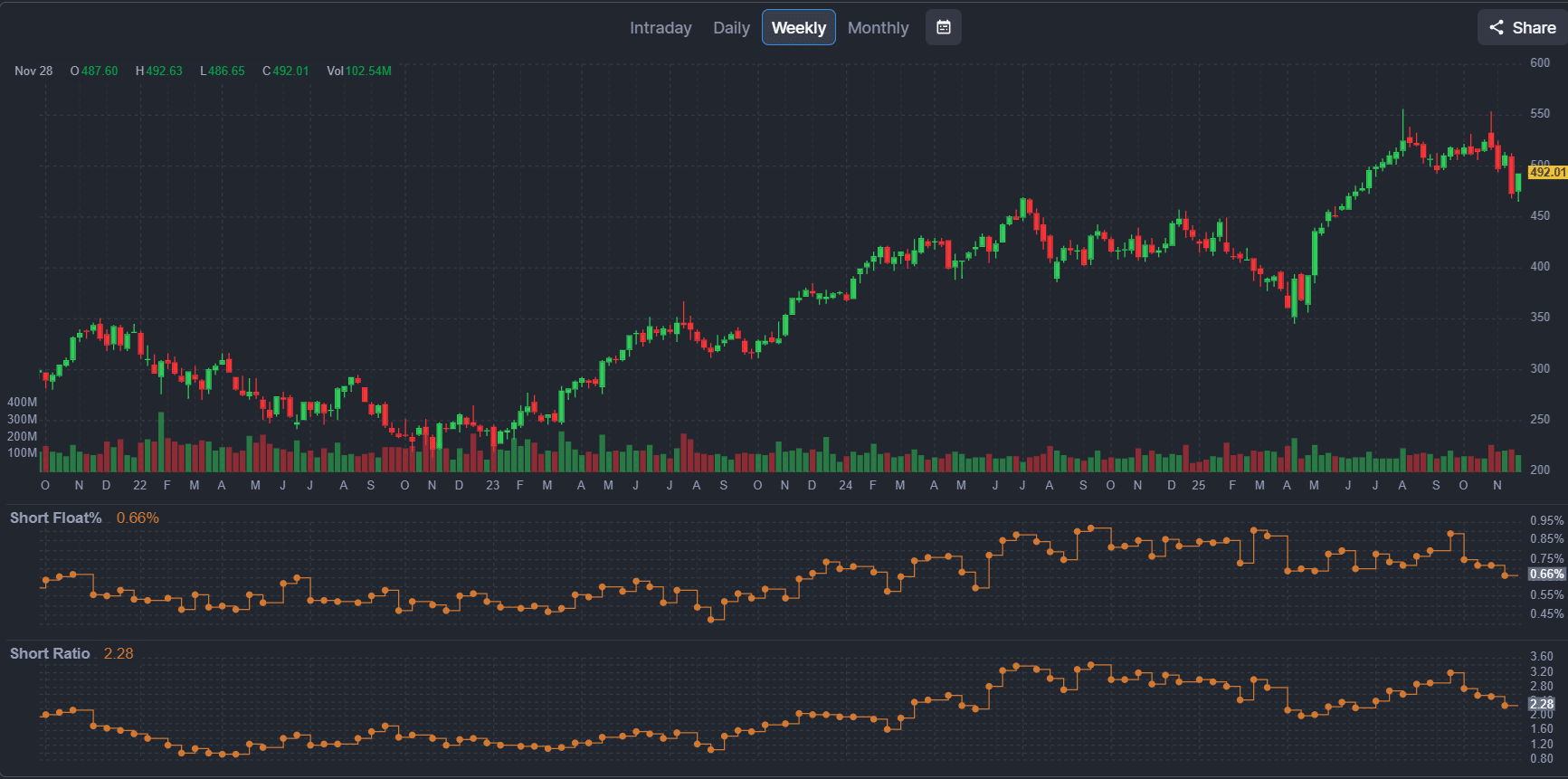
Short-interest data reinforces this constructive setup. With a short float of just 0.66%, bearish positioning remains extremely limited. This does not guarantee downside protection, but it does suggest that relatively few investors see a near-term catalyst for a significant pullback.
Risks to Consider
Despite the favorable outlook, several risks warrant attention. Microsoft’s valuation, even after accounting for long-term growth drivers, remains elevated compared with historical norms. AI monetization — while promising — is still developing, and the pace of enterprise adoption may vary. Azure’s growth, though stabilizing, may not fully return to the rapid rates seen in past years. Additionally, Microsoft’s scale in cloud, gaming, and AI continues to attract regulatory scrutiny, which could shape aspects of its future expansion.
These risks do not undermine the long-term thesis but highlight areas investors should continue to monitor.
Conclusion — Constructive Risk-Reward Setup
In our view, Microsoft stock’s current valuation offers a constructive setup based on several factors:
-
Analyst sentiment remains strong and broadly supportive.
-
The stock trades near the lower end of its price-target range.
-
Short interest remains minimal, suggesting limited bearish pressure.
-
Recent developments in AI and cloud reinforce long-term growth potential.
Taken together, these factors support the idea that MSFT can reasonably be considered for inclusion in diversified portfolios at present levels. While no investment is without risk, the current configuration appears balanced and favorable enough for long-term investors to consider.
Disclaimer
The articles, podcasts, and newsletters from Alaric Securities OOD are classified as marketing communications. The views expressed are solely those of the individual authors affiliated with Alaric Securities OOD and do not necessarily reflect the views of the company, its subsidiaries, or affiliates. This content is provided for informational purposes only. It does not constitute investment advice, a recommendation, or a solicitation to buy or sell any security, digital asset (such as cryptocurrency), or other financial instrument. Third-party content is included solely for informational purposes and does not reflect the views of Alaric Securities OOD. All investments involve risk, including the possible loss of principal. Past performance is not indicative of future results. References to third-party companies, logos, or trademarks are used under the principles of fair use/fair dealing for analysis and commentary.
Stay Ahead with Alaric Securities Newsletters
Traders and investors don't need more information - they need better information. That’s what we deliver!
Step back from the daily noise. Each issue explores market trends, industry shifts, trading opportunities, and exclusive updates — learn what's shaping the markets, not just what's trending online. Ready to get the edge?