Start every trading day with a quick, actionable snapshot of global markets, key earnings, and the biggest movers across US, Europe, and Asia. Get the insight before your first coffee is gone.
November 4, 2025
Pathways to Nasdaq: What Companies Need to Know
Alaric Securities

Insights from the joint Alaric Securities × Nasdaq event – Pathways to Nasdaq
The Pathways to Nasdaq event brought together founders, finance leaders, and capital markets professionals to explore what it truly means to transition from private to public. For those who could not attend, this article summarizes the key takeaways and provides context on the evolving dynamics of U.S. capital markets and modern IPO expectations.
Nasdaq’s Current Position: A Platform Built for the Future Economy
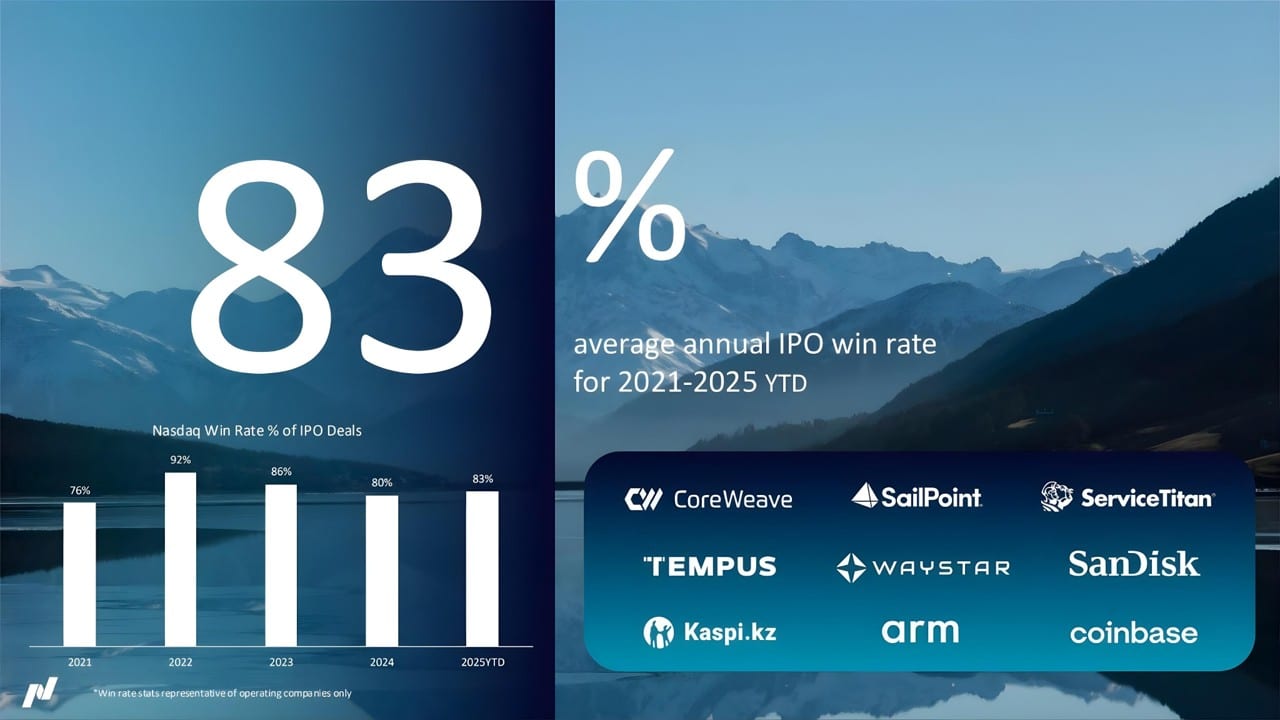
One of the most striking messages from the event was the scale of Nasdaq’s market dominance. More than $2.8 trillion in company value has migrated to Nasdaq in recent years, and nearly 80% of companies choosing to list in the U.S. selected Nasdaq.
This is not simply a trend — it reflects how closely aligned Nasdaq is with the industries shaping tomorrow’s global economy. Technology and telecommunications make up around 32% of listings, but the exchange has a highly diversified base: healthcare (22%), industrials (16%), consumer sectors (16%), and financials (14%).
The takeaway for companies is straightforward:
Nasdaq is not just for software giants or unicorns. It is a marketplace for any business driving innovation, scale, or transformation — regardless of size.
The Broader Context: A Market that Accepts Scale — With Conditions
The macroeconomic backdrop discussed at Pathways to Nasdaq suggests cautious optimism. Growth in major economies may be slowing, but the structural drivers remain strong. Inflation appears manageable, central banks signal potential rate adjustments, and capital is seeking stability and value — especially in sectors tied to transformation, innovation, or long-term secular growth.
One factor repeatedly emphasized is that the modern equity market is selective. Liquidity and capital are plentiful, but investors are looking for scale plus predictability. That means a company’s story must rest on more than ambition — it needs evidence: repeatable revenue streams, defensible market positions, and a clear roadmap for scaling responsibly.
This environment underlines an important truth: public markets will reward disruption, but only when it is packaged around consistency.
Why International Companies Continue to Choose the U.S. and Nasdaq
A recurring theme of the event was the reasons non-U.S. companies — including many across Europe — still choose Nasdaq over regional exchanges.
Three factors stand out:
- The deepest capital pools in the world
The U.S. equity market represents more than $62 trillion in listed value and handles over half of global equity trading volume. - Stronger valuation frameworks for innovation-led businesses
Sophisticated institutional investors in the U.S. understand scale, IP-heavy business models, and long-horizon growth. - Global visibility and credibility
A U.S. listing signals maturity, governance, and competitiveness—and opens doors to customers and partners worldwide.
One critical point clarified during the event is that the perceived difficulty of U.S. regulatory requirements is often overstated. While standards remain high, the SEC has become more welcoming to foreign issuers, and in many cases, the process is no more complex than listing on other major exchanges.
How IPO Structures Are Evolving
The Pathways to Nasdaq event highlighted that the IPO process has changed. Companies now have more flexibility than ever before.
Dual-class voting structures
Allow founders to retain strategic control, especially when paired with sunset clauses that provide investor reassurance.
Price-based lockups
Replace the traditional 180-day lockup with structures that allow insider selling only when the share price meets performance thresholds — aligning incentives between founders, employees, and investors.
Cornerstone investors
Large institutions committing early to anchor the offering have become a major stabilizing force, significantly reducing pricing risk.
These innovations have contributed to notable pricing success in recent years. In the 2023–2025 window, a remarkable 0% of IPOs priced below their expected range, demonstrating an environment where sophisticated structuring and investor alignment are paying off.
What Successful IPO Candidates Look Like Today
Companies that receive strong investor interest typically demonstrate several core attributes. They show predictable revenue patterns, evidence of scalable expansion, and growth rates often in the low- to mid-20% range. They may not yet be fully profitable, but they can articulate — with data rather than optimism — how and when profitability becomes achievable.
In short, the market is not demanding perfection. It is demanding visibility, discipline and a business model that investors can evaluate confidently.
Alongside these fundamentals, companies must also satisfy Nasdaq’s initial listing requirements. These criteria include thresholds for market value, shareholder equity, public float, liquidity, and board/governance structure. Evaluating these early helps leadership determine appropriate timing, valuation expectations and whether the company is better suited to the Nasdaq Global Market or Nasdaq Global Select Market.
Preparation: The Six-to-Twelve-Month Transformation
Another central theme was the reality of pre-IPO preparation. Going public requires a fundamental strengthening of internal operations, including:
- PCAOB-compliant financial audits
- Robust internal controls and reporting systems
- A refined equity story and long-term capital allocation plan
- An expanded board with independent directors
- Clear governance policies that meet public-company standards
For international issuers, additional disclosure requirements — particularly around cybersecurity and climate — mean preparation often begins even earlier.
Testing the Waters: The Most Meaningful Shift in IPO Execution
Among all insights, one stood out as transformative. Testing the Waters (TTW) has shifted from optional to essential.
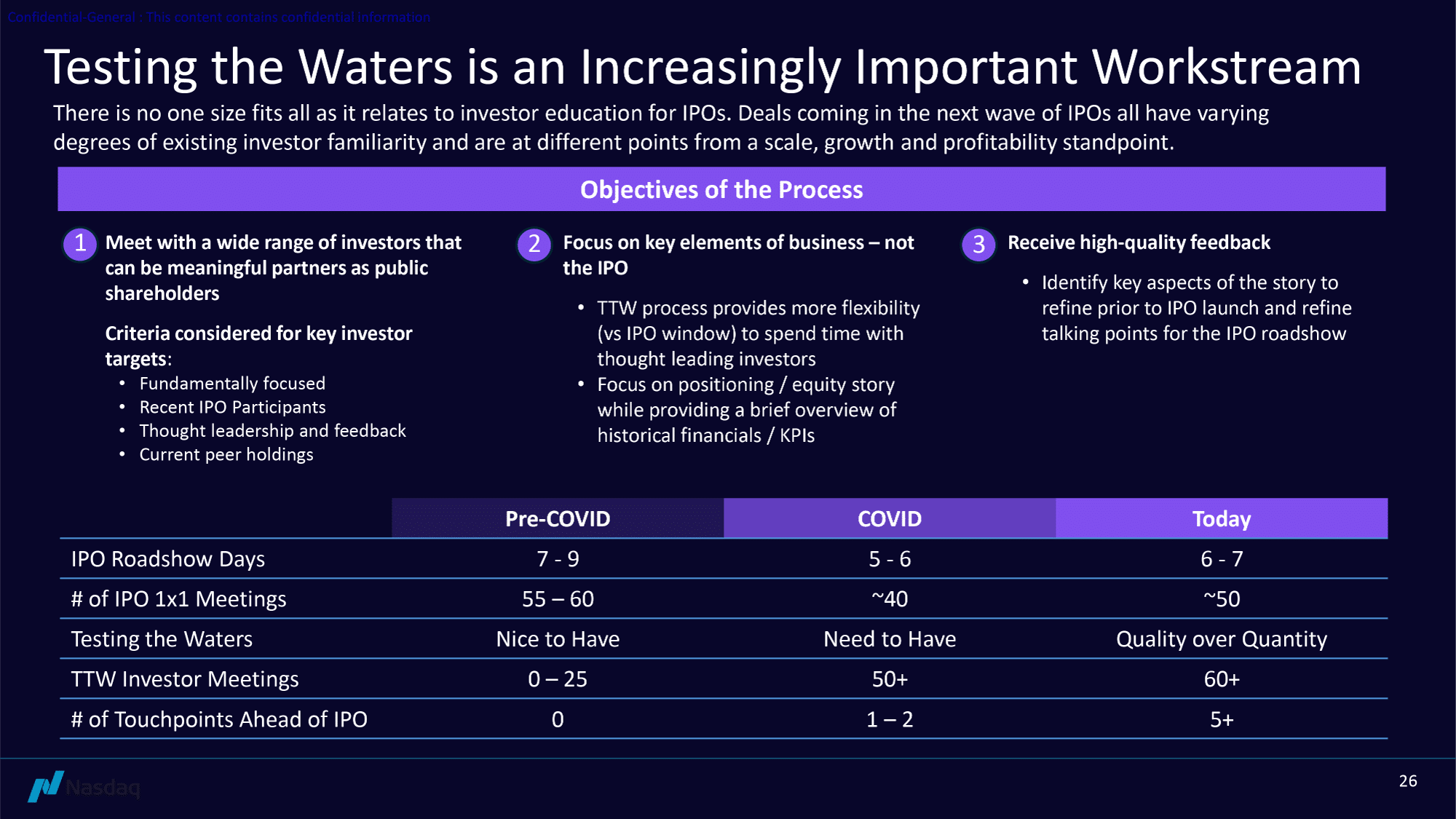
Before 2020, a company might conduct a handful of pre-IPO investor meetings. Today, leading issuers hold 60 or more — building relationships, refining their message, identifying cornerstone investors, and shaping valuation expectations well before the roadshow.
This extended early engagement is driving the increased pricing stability seen in recent years. It turns the IPO from a single moment into a months-long dialogue between a company and its future shareholders.
Looking Ahead: A New Investor Dynamic
The rise of TTW raises an interesting strategic question.
If investors now spend months engaging with a company before investing a dollar, how will this shape post-IPO expectations and behavior?
Will more profound pre-IPO familiarity create more aligned, long-term shareholder bases?
Or will it generate greater pressure on management teams to meet the expectations established during those pre-IPO meetings?
It is a dynamic that companies preparing for public markets must consider carefully and one that will likely define the next generation of IPO performance.
Key Takeaway
The Pathways to Nasdaq event highlighted a crucial truth – the IPO is not a transaction but a transformation. Companies that succeed on the U.S. public markets are those that begin preparing early, build internal discipline, invest in governance, and treat investor engagement as a continuous practice.
Nasdaq remains a powerful platform for companies with ambition and maturity and for those willing to take the journey seriously, the opportunity has never been stronger.
If your organization would like to explore IPO readiness or learn more about U.S. listing pathways, our team is available to discuss further.
Stay Ahead with Alaric Securities Newsletters
Traders and investors don't need more information - they need better information. That’s what we deliver!
Step back from the daily noise. Each issue explores market trends, industry shifts, trading opportunities, and exclusive updates — learn what's shaping the markets, not just what's trending online. Ready to get the edge?