
Start every trading day with a quick, actionable snapshot of global markets, key earnings, and the biggest movers across US, Europe, and Asia. Get the insight before your first coffee is gone.
May 19, 2026
Trump-Xi Meeting: A Calculated Move With Limited Market Impact
Alaric Securities
Anton Panayotov, Founder & CEO of Alaric Securities, on “Business Start”, BloombergTV Bulgaria
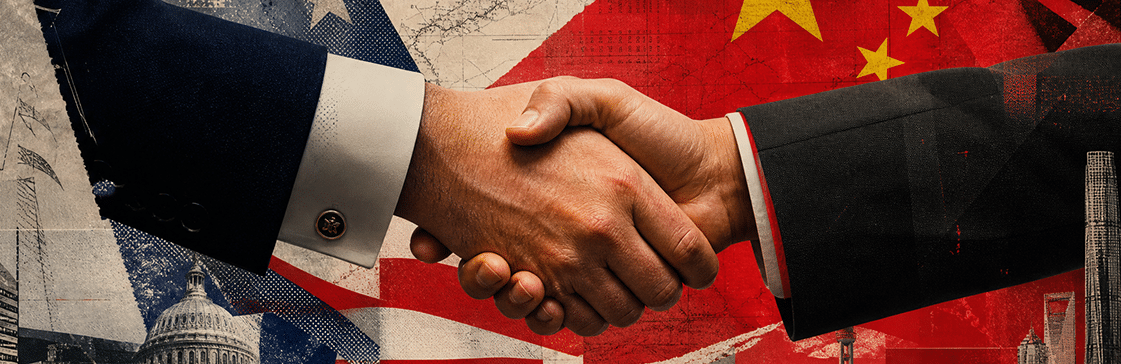
The Trump-Xi meeting came and went without major surprises. Some agreements were signed, hands were shaken, and a large business delegation walked the red carpet in what was, by most accounts, a carefully managed display of engagement. But beneath the surface, little of structural significance changed. For markets, the outcome was broadly in line with expectations and perhaps that is the most telling detail of all. This was stated by Anton Panayotov, Founder and CEO of Alaric Securities, on Bloomberg TV Bulgaria’s “Business Start” program, hosted by Hristo Nikolov.
What the Trump-Xi Meeting Was Really About
For China, the summit was a well-orchestrated show of force. For the United States, it served more as an attempt to divert attention from pressing domestic and geopolitical challenges. The fact that such a large American business delegation was paraded alongside Trump did signal one thing clearly – the U.S. economy is ready to do deals. Trump, after all, is a dealmaker by instinct and by identity.
But this was also a meeting between two leaders playing entirely different games. One is looking four years ahead. The other is looking twenty. When the time horizons are that misaligned, it is natural that one side pushes for fast results while the other is content to wait. The inconsistency in U.S. policy — friendly one day, adversarial the next — is not lost on Beijing, and China has shown little interest in being rushed.
China’s Position Is Stronger Than the Headlines Suggest
Over 45% of global manufacturing output is currently produced in China. Panayotov expects that share to grow — potentially reaching 60% in the years ahead. That is not a position that changes quickly, regardless of tariffs or summit communiqués.
Xi Jinping’s messaging around a so-called “fading empire” was notable — though Panayotov reads it as directed less at Washington and more at China’s broader sphere of influence. China, he explains, tends to view its regional satellites as its own — and prefers resolution through patience and alignment rather than confrontation. The recent removal of two senior generals from the upper ranks of the Chinese Communist Party is a sign that internal consolidation is ongoing, and that Xi is tightening his grip ahead of whatever comes next.
On Taiwan, the picture is equally layered. Part of the island’s semiconductor production has already been relocated to the United States — a strategic shift with long-term consequences. Taiwan remains a focal point for control over Pacific trade and military flows, and that dynamic is unlikely to change regardless of diplomatic atmospherics.
Energy – The Underappreciated Variable
One fact that rarely gets the attention it deserves: the United States is now the world’s largest exporter of both oil and natural gas. In 2018, U.S. oil exports stood at around 52,000 barrels per day. Today that figure is ten times higher. On the gas side, U.S. LNG exports already exceed Qatar’s, with an ambition to surpass 200 million cubic meters per year.
This matters enormously for the geopolitical calculus — and for markets. Whatever happens in the Middle East, the U.S. holds significant and growing leverage as an energy supplier. The question is whether that leverage can be deployed effectively, and quickly enough to matter.
What Markets Are Actually Watching After the Trump-Xi Meeting
The real concern is not the meeting itself — it is what comes after. The conflict involving Iran shows no signs of quick resolution. Strategic petroleum reserves provide some short-term cushion, but a prolonged supply disruption would shift inflation from situational to structural. That is a meaningfully different problem, and one that markets have not fully priced in.
Historically, conflicts between major powers tend to be resolved through proxy wars rather than direct confrontation. Panayotov sees no reason to expect this time to be different. The geopolitical friction is real, it is ongoing, and its economic consequences are beginning to accumulate.
On the rates front, neither the Fed nor the ECB is expected to raise benchmark rates in response. If any move comes, it would likely be a modest 25 basis points — and only if the inflation picture becomes impossible to ignore. The logic is straightforward: when inflation is situational, you do not restructure your entire policy framework around it.
UK gilt yields have already touched 5%. Japan’s fiscal situation remains under pressure. And if you take a longer historical view — inflation over the past 70 years has averaged around 2%. Current levels are a significant departure from that norm, and the adjustment will not be painless.
The Outlook: Turbulence Through Summer, Normalization in September
Panayotov’s base case is clear. The global economy is likely to face its most significant stress points in September — when the cumulative effect of unresolved geopolitical tensions, energy uncertainty, and fiscal pressure converges. There will be more pain before there is relief. But the expectation is that normalization begins around that point, and that the worst-case scenario — a full global recession — remains avoidable, if only narrowly.
For now, the Trump-Xi meeting is behind us. The harder part is still ahead.
Stay Ahead with Alaric Securities Newsletters
Traders and investors don't need more information - they need better information. That’s what we deliver!
Step back from the daily noise. Each issue explores market trends, industry shifts, trading opportunities, and exclusive updates — learn what's shaping the markets, not just what's trending online. Ready to get the edge?