April 3, 2026

How to Stop CFD Spreads From Eating Your Profits

Dilyan Fronov
Tech Engineer

I’ve lost track of how many times I’ve had this conversation. A frustrated CFD trader comes to me after putting in the hours and staying dead-disciplined with their entries and exits. They have a system that works – hitting 55%, maybe even 60% of their trades. By every textbook rule, they should be printing money. But instead of growing, their P&L is slowly bleeding. The first thing they usually say is, ‘My risk management must be off.’ They want to tweak their strategy. They look everywhere except at the real problem.

How Do CFDs Actually Work

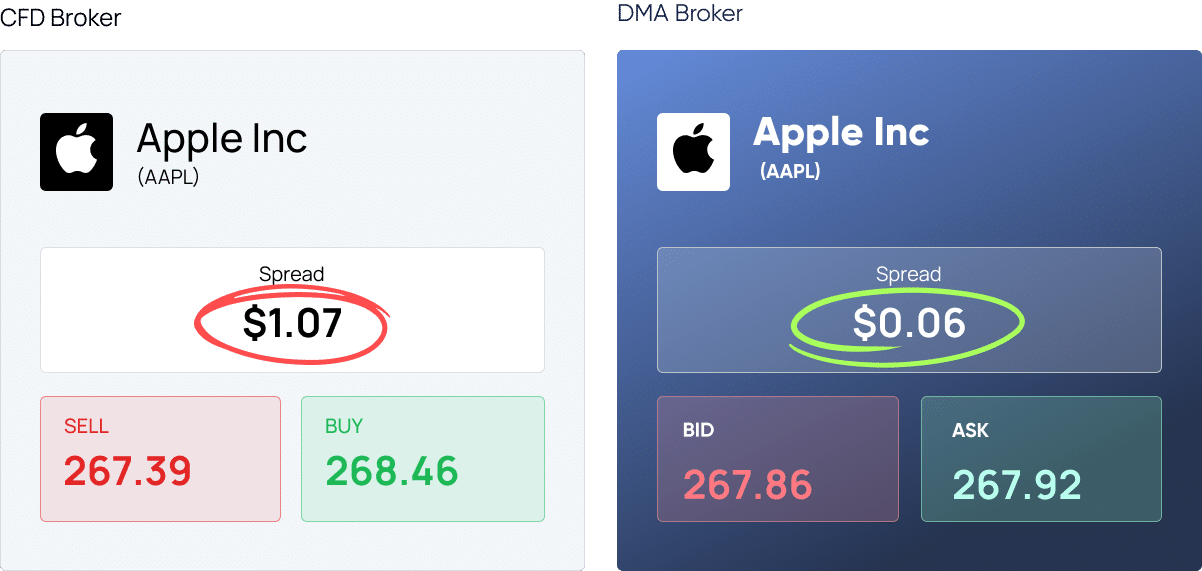
When they hear about CFDs, most people think it only means they are not getting the real stock. What they are really missing is the widened spread. Every stock has a spread. However, CFD brokers usually significantly widen that spread. If the average spread on most major stocks and indexes is 1 to 2 cents, CFD brokers can widen it to 5 to 20 cents, and in many cases even 40 cents.

The real problem is that there is no single real place where you can verify the best bid and best offer. 

In the US, all exchanges combine their quotations into the NBBO (National Best Bid and Offer). While that provides a single place of truth, you can only see those quotations if you trade real stocks through a true DMA broker.

In Europe, it is way worse, as there is no such thing as quote aggregation, and one stock can trade at different prices in Frankfurt, Paris, Amsterdam, or Milan. This leaves you with no idea of the real price when you trade and opens the door wide for CFD brokers to eat your pie.

What “Zero Commission” Really Means  

Everyone loves the sound of “zero commission.” But in trading, if the execution is free, the cost hasn’t disappeared – it has just been moved to a place most retail traders never look – the spread.

Let’s look at a hypothetical example using SPY, one of the most liquid ETFs in the world.

If you route your order directly to the open market using Direct Market Access (DMA), you interact with the National Best Bid and Offer (NBBO). In normal conditions, the real market spread on SPY is typically just $0.01 (one cent). That is the raw, institutional pricing.

Now, pull up the same asset on a typical zero-commission CFD platform. You will not pay a ticket fee, but look closely at the gap between the bid and the ask prices. Where the real market shows a 1-cent gap, the CFD platform might show an artificially widened spread of 10 cents, 20 cents, or even 40 cents.

The Math on a 100-Share Trade

Imagine you buy 100 units of SPY.

  • The CFD Route: If the broker has widened the spread to 40 cents, you are instantly down $40 the exact second you click buy. You have to wait for the market to move 40 cents in your favor just to break even on the trade.
  • The DMA Route: If you execute the same trade through DMA broker, you interact with the real 1-cent spread. That costs you just $1 in spread drag, plus a flat, transparent commission.

This is where the math catches up to active traders. “Zero commission” is simply a different pricing structure, and it usually works against high-volume traders.

If you are taking 10 or 20 trades a week, paying a widened spread instead of a raw market spread creates a massive drag on your performance. You are taking 100% of the market risk, but the widened spread is eating a huge chunk of your potential profit before the trade even gets going. You have to generate significantly more alpha just to cover the hidden cost of the spread.

The difference comes down to order routing. With a CFD, the broker is often your counterparty and internalizes the order. With DMA, your order goes straight to the exchange. You pay a clear, boring commission, but you get the real market price.

The Real Cost to You

Invisible Losses: Your trading account rarely shows a “spread” line item. You only notice when your balance doesn’t grow.

Fast-Compounding Costs: Ten round-trip trades per day at just a 2-pip spread costs you 200 pips a month. In money terms, that’s hundreds – sometimes thousands – lost, not to your strategy, but to your broker.

Death by a Thousand Cuts: Over time, these hidden fees can turn a winning strategy into a break-even or losing one.

If you’re trading actively, this adds up shockingly fast. Let’s say you make 10 round-trip trades a day. At an average 2-pip spread, that’s 20 pips in costs daily. Over a month, you’re looking at 400+ pips vanishing just from spreads alone, roughly 4% of a $10,000 account per month, or $400 a month gone. That’s nearly 48% per year and $4,800 eaten by spreads, not by bad trades.

The worst part? It’s nearly impossible to see. There’s no line item on your statement that says “spread cost: $200.” It’s just baked into your entry and exit prices. You have to go digging through your trade history and calculate it manually to even know what you’re paying.

The Money You’ll Never Get Back

Worst-case widening: if the CFD spread is 40 pips, that’s 0.4% per trade. If you’re not trading heavily, that’s about 10 trades per month. With a DMA broker, the spread will cost you 0.2% and with a CFD broker, it will cost you 4% – that’s 20 times more. Now imagine you trade 10 times a week, not a month, and your first return will go to the CFD broker, not to you.

Trading costs don’t just trim a little off the top  –  they pile up against you. It’s a slow bleed. Let’s do the math. Say you fund an account with $10,000. Your strategy is solid, delivering a 2% monthly return before fees. By the end of the year, you should be sitting on roughly $12,682 – a 26.8% return. But if you’re paying 1% per month in spread costs – which is entirely realistic for active traders – your actual returns drop to 1% per month. After a year, you’d have $11,268 instead. That’s $1,414 less – an 11.2% hit to your gains, just from costs. Stretch that over three years and the gap balloons to over $4,000, a 29% difference – same strategy, same trades, different broker.

Now extend that over two, three, five years. The gap gets wider and wider. The money you could have been reinvesting and growing isn’t there anymore. A piece of your hard-earned profit vanishes into your CFD broker’s pocket.

That’s why professional traders are somewhat paranoid about execution costs. It’s not about being stingy – it’s about knowing that tiny leaks sink ships. A DMA trader paying a 0.3% commission is going to leave a CFD trader paying a 1% spread in the dust over time, even if they are clicking the exact same buttons.

The frustrating part is that most retail traders never do this math. They focus on improving their win rate by 2-3%, which is hard and takes months of work. Meanwhile, they’re ignoring costs and eating 1% or more of their account balance every month. You can’t grow money you don’t keep. And with CFD spreads, you’re not keeping as much as you think.

Why Direct Market Access Changes Everything

When you step away from the murky water and finally look at a clear glass, it’s like taking off a blindfold you didn’t even know you were wearing. That’s the power of Direct Market Access (DMA). It doesn’t magically make you a better trader overnight, but it strips away all the friction. 

You stop battling artificial spreads and platform delays, and you finally get to focus 100% of your energy on the market itself. That is what Direct Market Access (DMA) does to your trading terminal. It doesn’t magically make you a better trader, but it fundamentally changes the mechanics of how you trade. You finally get to stop fighting your infrastructure and focus entirely on the market itself.

When you route an order through a DMA broker, it doesn’t drop into a black box. It goes straight to the exchange. You are suddenly interacting with the actual financial ecosystem: institutions, liquidity providers, and other traders who have real skin in the game.

The immediate difference you notice is the pricing. The numbers flashing on your screen are the raw market feed. There are no artificial mark-ups. There is no dealing desk deciding to pad the spread by an extra pip just because a major news report is about to drop. You see the true market rate and trade at it.

Because the prices are real, the way you pay for the trade changes completely. Instead of paying your broker through a hidden, elastic spread that balloons exactly when you need to enter or exit, you pay a straightforward commission. It’s a boring, predictable line item. You know exactly what the toll booth costs before you even put your car in drive.

With DMA, your broker is no longer your counterparty. We are simply the pipeline connecting you to the market. We get paid our flat commission whether your trade goes to the moon or hits your stop loss. For the first time, you and your broker are actually on the same side of the table. You are trading against the market, not against the house.

For any active trader, this level of transparency changes everything. When your costs are fixed and visible, you can finally measure your true performance. You can mathematically prove whether your strategy has a genuine edge after fees. You stop guessing if a bad fill was due to market volatility or broker manipulation, and you start making decisions based on hard, verifiable data.

When Should You Care About This

I’ve seen traders do this exercise and realize they’re paying two or three times what they thought they were paying in trading costs. It’s eye-opening. If you’re trading multiple times a week, if your account has grown beyond the “just experimenting” stage, if you’re serious about this, sit down and calculate what you’re actually paying in spreads. Take your last three months of trades. Count them up. Look at the typical spreads for what you trade. Do the math.

The Switch That Pays for Itself

Look, I get it. Switching brokers is annoying. There’s paperwork. There’s a learning curve, even if it’s small. It’s easier to just stick with what you already know. But trading is hard enough without handicapping yourself with costs you can’t even see clearly.

If you’re putting in the work to improve your strategy, your discipline, your risk management – all of that – it seems crazy to let hidden fees undermine it all.

Direct Market Access requires slightly higher minimum deposits. The setup is a bit more involved. But you get real market prices, transparent costs, and execution that doesn’t depend on your broker’s mood during volatile periods.

For traders who are serious about this, who want to actually grow their accounts over time, those advantages add up. You keep more of what you earn, finally know your real costs, and can measure your actual performance.

The best way to understand the difference is to see it firsthand. Open an account with Alaric Securities and compare the spreads yourself — on the same instrument, at the same moment.

Disclaimer

The articles, podcasts, and newsletters from Alaric Securities OOD are classified as marketing communications. The views expressed are solely those of the individual authors affiliated with Alaric Securities OOD and do not necessarily reflect the views of the company, its subsidiaries, or affiliates. This content is provided for informational purposes only. It does not constitute investment advice, a recommendation, or a solicitation to buy or sell any security, digital asset (such as cryptocurrency), or other financial instrument. Third-party content is included solely for informational purposes and does not reflect the views of Alaric Securities OOD. All investments involve risk, including the possible loss of principal. Past performance is not indicative of future results. References to third-party companies, logos, or trademarks are used under fair use/fair dealing principles for analysis and commentary.
Stay Ahead with Alaric Securities Newsletters
Traders and investors don't need more information - they need better information. That’s what we deliver!

Morning Bell

Start every trading day with a quick, actionable snapshot of global markets, key earnings, and the biggest movers across US, Europe, and Asia. Get the insight before your first coffee is gone.

Trader Insights

Step back from the daily noise. Each issue explores market trends, industry shifts, trading opportunities, and exclusive updates — learn what's shaping the markets, not just what's trending online.